
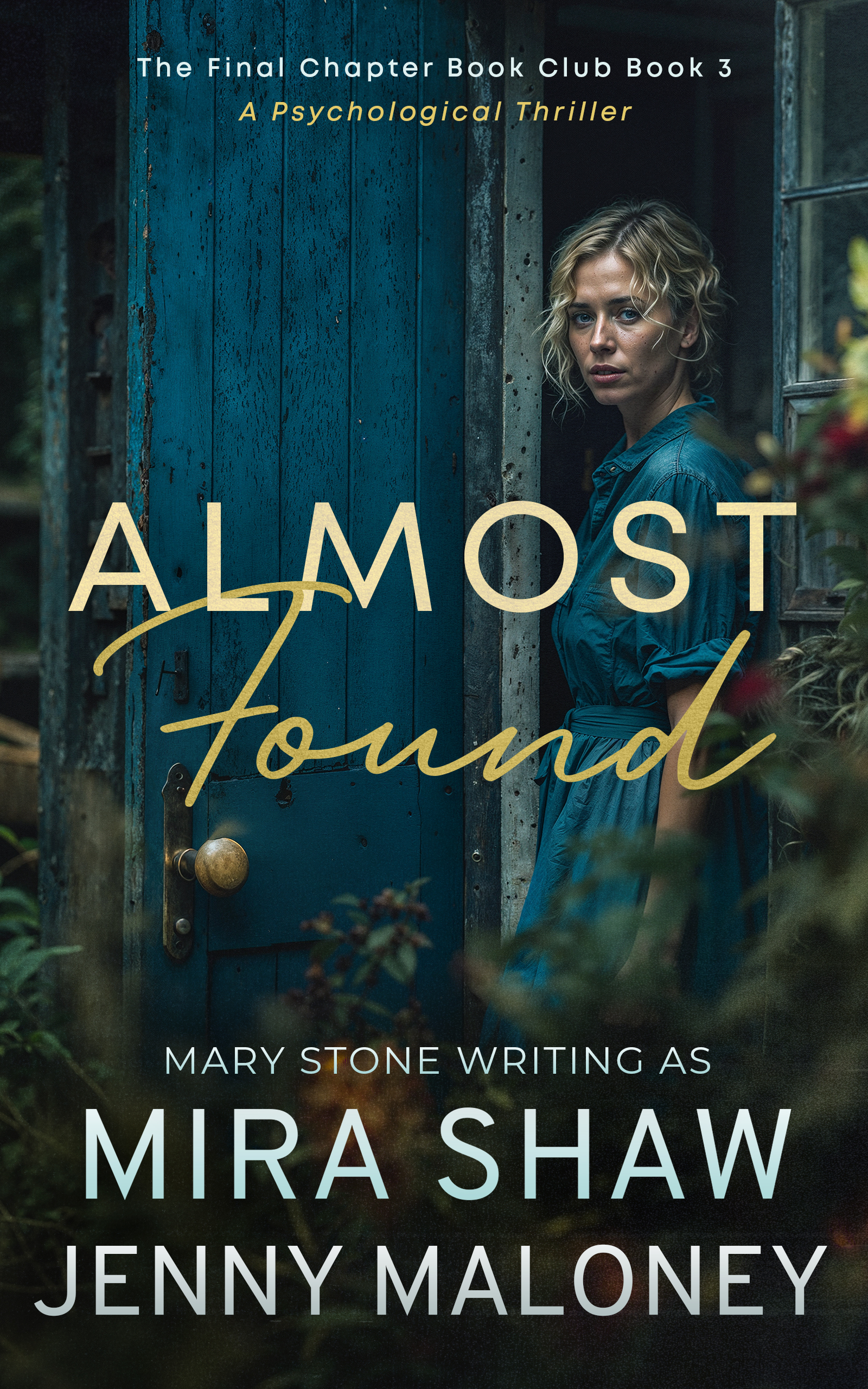
Today is the book birthday of my first full-length novel, Almost Found.
Important note: Even though this is “Book 3” in the series, you don’t have to read them in order. The books in the Final Chapter Book Club are all standalone.
There are no large fanfares and no big book tours coming, but today is the mile marker I’ve been working toward for years. I’m not going to say how many years — don’t ask. Forget it. Let’s just say plenty of years. Almost Found is my first published full-length novel, but it is the sixth I’ve written.
Years ago, I read that, on average, it’s the sixth or seventh book that is an author’s “first” or “debut” book. Of course, way back when I heard that, I said to myself, “Self, that will not be you. You will certainly publish by book three.” I even internally praised myself for being so magnanimous as to wait for three whole books.
Ah, youth.
Here’s the wisdom I’m about to drop on you:
Lessons take as long as they take. Sometimes lessons are repeated until you learn them.
Writing is a craft. Storytelling is a craft. They are separate, yet tightly related, crafts — and it takes a while to learn to integrate them effectively. If you’re going to write good books, plays, stories, poems, or whatever, then you must learn how to write. You must learn how to communicate your ideas in a clear, concise way. Because if no one understands what you’re getting at, you’re dead in the water. That means you need to learn sentences, paragraphs, grammar, and rhetoric. Then, if you’re going to tell a good story, you need to learn about characters, human nature, setting, dialogue, plot, structure (not the same thing as plot), and storytelling traditions.
And those are just the basics. I’m not even touching on the soul-searching, heart-mining, or mind-bending we have to do along the way.
Today, even though I’m thoroughly enjoying Almost Found being out in the world, I keep thinking about the books that taught me so much — giving me the capacity to even do this.
These books won’t see the light of day in their current states (under the bed), but pieces of them exist in Almost Found and will exist in every single book I write from here on out. Here’s what I learned from them, and I hope your under-the-bed books teach you as much.
The Books That Built Me
Book 1: On the Last Night
A horror/thriller. A demon comes to earth looking for the Spear of Destiny, which is being protected by a “freak” carnival. The spear was stolen from Nazis in the 1940s and then buried in what turned out to be my hero’s backyard. Yeah. It’s…a lot. Nazis, WWII, a neighborhood dad, a religious relic. Maybe Dan Brown could do something with it, but not younger me.
But the lesson it taught me is probably the most important one I will ever learn.
If you’re a writer, you write.
I wrote almost 200,000 words of this mess while breastfeeding a newborn baby. I drafted it from beginning to end. I got to the end and realized that I had a lot more to learn — but I also knew that I could sit down at a desk and put words on a page.
Book 2: Following Julia Roberts
Almost the entire opposite of On the Last Night. It’s 60,000 words — so much shorter. An attempt at a mainstream novel about the meaning of love. In case you’re curious…I was in college at the time and trying to be “literary” and “smart,” and it turned out that I was neither of those. (I’m kinda smart, but not enough to pull this story off, apparently.) It’s not all bad though. I just didn’t say what I needed or wanted to say — the gap between The Vision and The Reality was more of a Grand Canyon situation.
But I did get better at understanding what makes characters tick. And I won a prize for “Best Tension” in an excerpt contest — so I nailed at least one scene.
Book 3: When La Llorona Weeps
Still in college. After Following Julia Roberts, I thought: horror and thriller is my jam, so I’m going to return to genre. But I was still very much in the Literary Mode of things — so my pretentious self attempted to be some kind of white, horror Sandra Cisneros or Isabel Allende. Two writers I love and greatly admire. Magical realism? Sign me up.
But the lesson here is that admiration for another culture’s stories is very different from those stories being yours to tell or create a variation of.
I’ve lived in the Southwest almost my entire life. I’m surrounded by the cultural influences of indigenous cultures, Mexican history, and remnants of language. However, I was not born to that culture — it’s not my place, no matter how much I love it, respect it, or live adjacent to it. It wasn’t until I introduced a white woman character who couldn’t understand the town she lived in that I realized that’s the story I have access to. And I think I’ll still explore that psychologically complex character in a different book someday.
If you’re tempted to write about a different culture’s legends and interiority: continue to admire those stories, respect them — but don’t try to create them. Encourage your friends who are intimate with that culture to tell their own stories.
Book 4: The Kingdom Chronicles: The Talker
Designed to be the first in a middle grade series. (Someone here is very slow to learn that genre-hopping is no good for your career…)
It’s about a pair of twelve-year-old twins who can talk to animals and discover that an animal uprising is coming. Very fantastical. I wrote it for my oldest son, who loved reading and practically worshipped the Warriors series. At the time, I was running the children’s department at Barnes & Noble and thought, “I can take J.K. Rowling.”
What this one taught me: I could write a cohesive book fast if I had a personal, inner connection to why I was writing it. Because I was writing this one for my son, it was easy to sit at the computer and imagine what he’d like. I forgot this lesson for a while, but now it’s fully integrated. If I believe in what I’m writing, the writing flows.
Book 5: Someone Who Can Help
This one is actually coming out later this year — keep your eyes peeled!
Someone Who Can Help is a near-future psychological thriller. Think John Marrs or Blake Crouch. It has a lot of complicated pieces. I sent it out to multiple agents, got several full novel requests, and a ton of agent notes on how to revise it. Some were contradictory. Some were so obvious I wished I’d seen them first. Such is the way.
This one taught me that — as the saying goes — great writing is rewriting.
Seven full-length drafts over three years. If you’re a writer, this is almost as harsh a lesson as Lesson One. Not only do you have to sit down and focus for the first draft, but you have to do it over and over and over again.
Bonus Teachers: The Plays
🎭 The Gnome in the Room — a play I co-wrote with my creative soulmate Jessica Weaver. This taught me that in collaboration, whoever is the most passionate about an element wins. If you got this month’s newsletter, I talked about how that lesson served me when working with Mira.
🎭 TIG: A Modern Adaptation of Sophocles’ Antigone — You know how I said The Kingdom Chronicles: The Talker taught me I needed a personal connection to the material? I actually forgot that lesson until very recently. I wrote a new version of Antigone for a local high school (production in April!). It’s about censorship and keeping youth quiet. Turns out, I’m pretty passionate about those subjects and about making sure our teenagers have a chance to explore topics that are important to them. (More on this in a future post — stay tuned.)
How All of It Shows Up in Almost Found
All of that writing informed this book, lesson by lesson:
Lesson 1 — Butt in seat. Write the words. Almost Found was written over the holidays, during a writers’ conference Mira and I attended together, and during a restructure at my day job.
Lesson 2 — Create characters readers can invest in. I’ve spent a lot of time with Sabrina Kane, Kitty Matheson, and Clara Armstrong-Little over the past year, and I hope I’ve captured their voices and points of view in a way that’s genuinely engaging.
Lesson 3 — Tell a story that is yours. The story is about a group of Southern women who love family. Both Mira and I have deep roots in the South — mine in North Carolina, hers in Tennessee. The setting and the women all feel authentic to me.
Lesson 4 — Be passionate about the story. Sabrina’s longing for a full family, to know her origins. Kitty’s constant mistakes but ultimate heart. Clara’s badassery despite such harsh setbacks. Am I passionate about all of that? Check, check, check.
Lesson 5 — Revise. There were many editorial passes at this novel. Many drafts passed between Mira and me. Discussions that delved deep.
Bonus Lesson 6 — Collaborate. Passion winning. Listening, working together. Mira and I had extensive discussions — and occasional debates — about Sabrina’s arc, whether or not to add a character (if you read the book and like Sabrina’s little sister…go thank Mira!), and sometimes we got as granular as a single sentence.
If you get a chance to read Almost Found, please drop me a line and let me know how these lessons played out: jenny [at] seejennywrite.com
Leave a Reply