
The boy read an article about a lake with a thousand skeletons somewhere in the Himalayas. He’s never been to the Himalayas, though his father once climbed Everest.
He never imagined he would see a skeleton beneath the ice, but here one is, caught in the weeds by the shore of the lake.
He stands there among the cattails, alone at night, and wonders what to do. He brushes the cattails, crispy with winter, with his fingertips, as he contemplates his next move. The park is isolated, more of a wilderness sanctuary that abuts the campgrounds spotted with wilderness cabins—one of which his father and soon-to-be-stepmother are occupying. The trail to get here is not well kept and almost no one uses it except the most enthusiastic of dog walkers. This lake doesn’t even have a name, just “recreational wetlands” on a sign near the entrance. No one would come here with someone they loved.
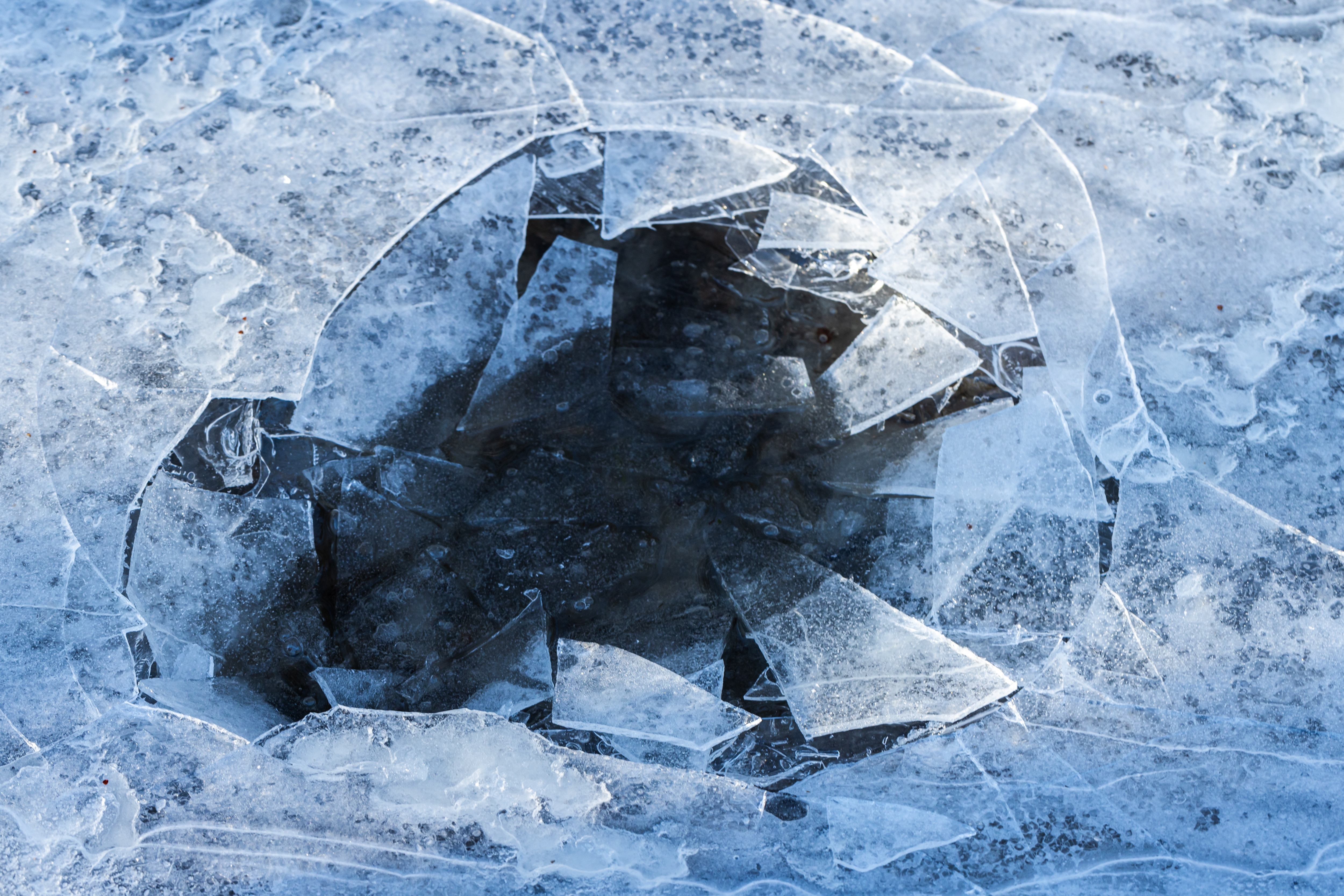
The ice is silvery, and it’s hard to see through it, almost opaque, with bubbles caught on the surface. He wonders if the bubbles come from gases expanding out of the corpse. He’s heard that can happen sometimes—science is his favorite subject. It’s like looking through a foggy mirror. The light of his phone flashlight isn’t doing much. He steps onto the ice to get a better look.
In the summer, which is when he guesses the skeleton was just a body, the water would’ve lapped at his knees. But the winter months have frozen everything solid. Still, he hears his father’s voice in his head, telling him not to go out over the ice. But he’s feeling bold. Stepping out onto the ice is his first act of defiance against his father for a few weeks.
He doesn’t think this skeleton is a child, even though it is small. Possibly a woman. For a split second, he imagines that the skeleton below the surface is his soon-to-be-stepmother, and with her out of the way, his family will stay together. But then he stops the thought in its tracks.
He doesn’t want to think about the death of anyone close to him. Even his soon-to-be-stepmother. He still can’t even tell if this is a woman anyhow. He kneels down on the ice to get a better look. He’d seen skeletons before. His father had once taken him to the Cleveland Museum of Natural History—and there had been so many bones. He’s seen the human skeleton, the human skull. The skull beneath the water is shaped oddly. Slightly concave. He assumes the person hurt themselves—or maybe someone hurt them. But the skull seems larger than a normal head. Magnified, he supposes by the ice.
Out farther on the lake, in the middle, the ice groans as if carrying an unbearable weight, but he doesn’t panic. He’s nowhere near the black ice. This sheet is as solid as a skating rink. The knees of his snow pants slide along the surface and he overshoots the skeleton by about a foot.
When the sound comes, he doesn’t expect it, barely recognizes it as a sound initially.
A low thrum, he feels it in his chest more than in his eardrums, like a tiny radio filled with static. He wonders if someone is running an RV engine or if a train is in the distance. He can’t tell if this is how all sounds are out here, reverberating off the mountain walls surrounding the valley. But the sound, or vibration, or thrum, or whatever, seems to come from above. He looks up. The stars are shining in a way they really can’t in the city. For once he understands why constellations looked like things, like pictures, to the ancient people.
Then something shifts among the stars. At first, he almost misses it, a slide of wispy clouds, a flicker of movement. Like the sound, it’s almost imperceptible. It’s almost like a piece of the sky shifts, like a piece of the sky relocates itself. An instinct he doesn’t realize he’s had his whole life until right now comes full to life. The urge to run, to get out of the way. The heavy piece of sky, which now also looks like metal, floats down. He almost thinks it’s falling, it’s going to collapse on him. The thing—the thrumming thing, his chest is really vibrating now—lands in the field between the lake and the boy’s way home. His route home is blocked. He skitters out onto the ice, over the skeleton, over the frozen fish, away from the cover of the cattails. Skeleton forgotten, he wants nothing more than to be away.
The frozen lake is the only escape route. Out here, the world feels completely black. And it is groaning.
Despite the light from the stars, there’s a curtain falling over him. The cold seeps into his muscles, like the night is trying to soak into him, to freeze him as solidly as the skeleton under the frozen water. But he thinks he’s far enough away that whatever the vehicle is—is he seeing a UFO?
His uncle often told him stories about aliens, but his dad said to ignore his brother. He was a drunk. But the boy’s brain is trying to put fragmented pieces of information together despite what his father said. The skeleton under the ice hadn’t looked quite right. He’d thought the ice or injury had been distorting the skeleton’s features. Not that the skeleton was an alien skeleton. As he sits out on the ice, shivering, he hears the ice groan again. Winter doesn’t have as firm a grip on the water as he thought. Though it’s cold, the temperature has stretched far enough to affect the currents beneath him. He stays very, very still, not wanting to draw attention or break the surface.
The cattails part and three bright lights, strobing between colors so fast the beams look white, but have a shifting, disorienting quality. Through the strobing, he sees others have converged on the shore line. They are cracking at the ice and everything sounds deep, like thunder. They bend and break cattails out of the way. They are pulling the skeleton free.
In the article about the skeleton lake in the Himalayas, the boy had read that the skeletons were from different time periods. He wonders if any of them were from different places too. Or if aliens always came for their own eventually.
The lights flash across the sheet of ice as the aliens work. He flinches away from it, not wanting to be seen. They are almost done if he doesn’t miss his guess. But even his small movement catches the attention of the men—they might be men, alien men—on the shore. Footsteps rush toward him. The deep thunder sound grows louder, more high pitched. Closer. He looks down and sees the ice beneath him is dark, black, like the water beneath it. A crack spreads beneath his knee and he feels water soaking through his nylon pants.
The sensation only lasts a moment before the lake surface gives way beneath his weight, and a light blinds him before he collapses into the water. He gets one solid breath before plunging below.
The shock of the cold compresses him, and he doesn’t feel like inhaling yet. His soaked clothing is an anchor. He can feel the pull of them. Looking up, he sees the world through a dark tunnel.
The stars seem magnified. Orion’s belt gleams in the distance, but it feels like he might reach out and pluck one of the stars. His hand even reaches up. The stars glow brighter and he can’t tell whether he’s floating or falling. He could be doing both. The icy water is how space would feel, he’s certain. Everything, his father, his soon-to-be-stepmother, the skeleton at the shore, all of them are light years away. It is only him, in the oxygen-less vacuum of space. He hadn’t understood what that meant when his teacher explained it. Now he knows. It is cold. And it is nothing. His lungs release the last breath he’d taken. Bubbles float up and he remembers the bubbles around the alien skeleton’s skull—a last breath frozen in place.
Before the world shrinks to a narrow band of darkness, the universe exploded in light. A supernova.
Hands with six fingers grasped him, reaching down from the hole his body had created in the lake surface. He was lifted straight up, as if he and his soaked clothing weighed nothing. He burst forth from the water, gasping and choking. His rescuers yanked him toward the shore, dropping him among the cattails. A face peers down at him. The eyes look almost human, with irises larger and purple. The eyelids blink sideways and he realizes this person isn’t a person, or is, but isn’t. He can’t get his brain to track all the details. There’s something off, but still human, about whoever is looking down at him.
Seeing that he’s breathing, the human creature moves away from him. The boy sits up and watches the others pull the last bones of the skeleton from the ice, lift it onto a tarp, and then carry it to where the horizon seems off, distorted. The thrum returns, and then disappears. The horizon distorts, then rearranges itself. The horizon is just a horizon again. All that’s left is a boy shivering, staring into the stars, and wondering.
Leave a Reply